


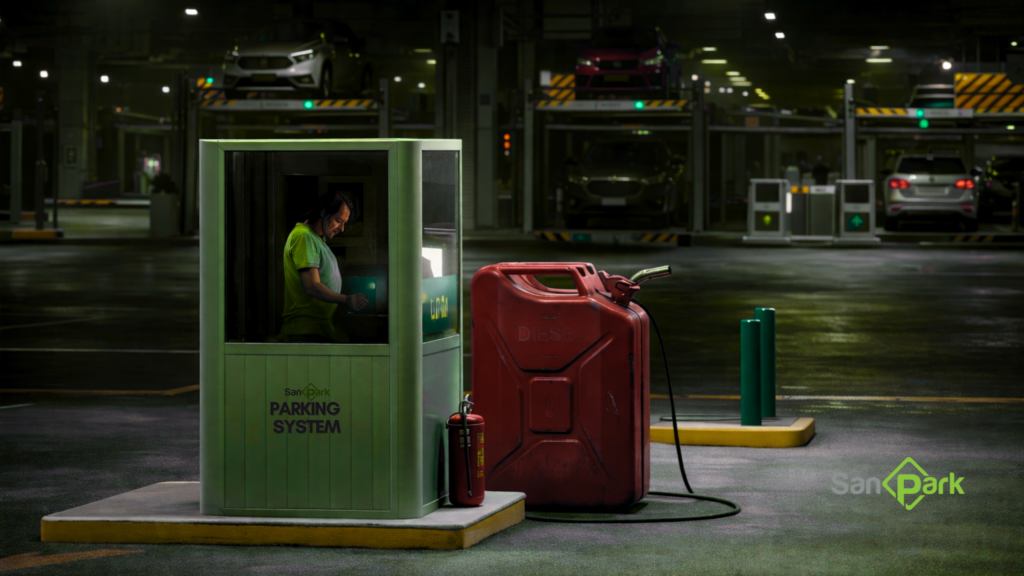
One of the biggest sources of stress in city life is the “second journey” that begins after reaching the destination: Searching for a parking spot. While this process may seem like a delay of just a few minutes for drivers, on a macro scale, it translates into massive economic loss, traffic congestion, and environmental pollution.
In this guide, we will deeply analyze the concept of “search traffic” (cruising) which reduces parking efficiency, and examine how time and fuel savings can be achieved with scientific precision using smart parking systems.
Parking Search Problem: Why are Time and Fuel Lost?
When you enter a parking lot or look for a space on the street, the resources you waste are far greater than you think. During this process, not only do minutes tick away, but significant amounts of fuel and energy are wasted at moments when your vehicle is operating most inefficiently.
The “Cruising” Effect: Why Do We Keep Circling in the Parking Lot?
What is the parking search traffic known in the literature as “Cruising for parking“? This concept defines the traffic created by vehicles that have arrived at their destination but continue to circulate at low speeds because they cannot find a place to leave their vehicle. The answer to the question drivers ask themselves, “Why am I constantly circling in the parking lot?” is a lack of instant information. It usually stems from an inability to access empty spot information, insufficient guidance, or a misleading perception of occupancy. This uncertainty creates parking search stress and negatively affects driver behavior.
Why is Fuel Wasted While Looking for Parking?
The cruising process is the moment when the vehicle operates most inefficiently. Parking search fuel consumption is 40% higher than normal driving because the vehicle is constantly in 1st or 2nd gear and making frequent stop-and-go maneuvers. In particular, the effect of stop-and-go driving prevents the engine from achieving complete combustion. This situation affects not only your wallet but also the planet; carbon emissions (CO2) and toxic gas emissions while searching for parking increase exponentially as idling time extends.
The Impact of Time Lost Searching for Parking on Daily Life
Studies show that a driver living in a metropolitan area spends approximately 100 days of their life searching for parking. The anxiety of “Why am I losing time looking for parking?” combined with the fear of being late for work lowers the quality of life. Time loss in parking is not just an individual problem; for businesses, it represents an operational inefficiency that translates into customer loss.
Why Can’t Empty Spots Be Found When They Exist?
Sometimes, even though a parking lot looks completely full, there are actually spaces available in back corridors or on upper floors. However, without correct information, a parking spot that physically exists is considered “non-existent” for the driver.
Perception or Reality? Misleading Occupancy Perception
Why does finding a parking spot seem difficult or impossible for drivers? The main reason for this is the difference between “perceived occupancy” and “actual occupancy.” Seeing congestion at the entrance, the driver concludes there is no room inside. This inability to find a parking spot stems from the failure to correctly communicate existing capacity to the driver, rather than a lack of physical capacity.
Lack of Guidance and Blind Spot Areas
In large parking lots, the answer to the question “Why can’t empty spots be found when they exist?” is a lack of guidance. Static signage and lack of information send the driver on a random route rather than to the nearest empty space. Spaces in “blind spot” areas that the driver cannot see are doomed to remain idle unless there is a digital eye (sensor/camera).
Where Does Traffic Congestion From Parking Searches Come From?
A vehicle looking for a parking spot slows down not only itself but all the traffic behind it. This is one of the biggest hidden factors disrupting the fluidity of urban traffic and triggering congestion.
The Effect of Parking Search Time on Urban Traffic
Approximately 30% of the density in city centers consists not of people going from one place to another, but of those looking for parking. The effect of parking search time on traffic leads to the clogging of main arteries. Urban parking search traffic creates a chain reaction of slowing down by occupying lanes that should be flowing.
Why Does Traffic Occur Inside Parking Lots?
In enclosed areas, traffic congestion caused by parking searches is more pronounced in tight maneuvering areas. Drivers slowing down in hopes of finding a spot or reversing extends the queue of vehicles behind them. So, why is there traffic in the parking lot? Because slowness at entrance barriers and irregular circulation inside turn the parking lot into a labyrinth.
How to Reduce Parking Search Traffic?
Solving this problem is possible by removing the “luck” factor and replacing it with “data.” Thanks to technological infrastructure, driver behaviors become predictable, and traffic flow is optimized.
Giving Empty Spot Information to the Driver in Advance
The first rule of reducing traffic is to provide real-time occupancy information. The driver should know if there is space before entering the parking lot or turning onto the street. This is a strategy of eliminating uncertainty; the driver never enters a full area but heads directly to an available one.
Preventing Unnecessary Circulation with In-Parking Guidance
Smart guidance systems give clear commands to the driver, such as “Turn right, 3 spots left,” via LED indicators placed on the parking lot ceiling or mobile apps. In this way, the goal of reducing parking search time is achieved, and vehicles reach their destination without getting lost in the labyrinth.
Accelerating Entry-Exit Flow
Automatic opening of barriers with License Plate Recognition (LPR) systems is critical in reducing stop-and-go traffic. The digitalization of payment and ticketing processes provides internal traffic optimization and prevents queue formation.
How Do Smart Parking Systems Prevent Time and Fuel Loss?
Technology enables a transition in parking management from a reactive structure (intervening when a problem occurs) to a proactive structure (preventing the problem). Smart systems transform the parking lot from static concrete into a living and thinking organism.
What is a Smart Parking Guidance System?
Parking guidance technologies using ultrasonic sensors or cameras monitor the occupancy status of each parking space instantly. Sensor-based parking systems turn the light above the empty spot green, allowing the driver to see that spot from meters away.
How Does Real-Time Parking Occupancy Information Work?
The system processes the instant data flow collected from the field on a central server. This data is transmitted to mobile apps, roadside Variable Message Signs (VMS), or in-car screens. This is a protocol that reduces time loss to zero thanks to communication between the driver and the system.
Reaching the Empty Spot Directly with Parking Navigation System
An advanced AI-based parking spot finding system takes the driver from the parking gate and navigates them to the empty spot number 34. This parking navigation system completely eliminates the search process.
How Do AI-Supported Parking Systems Work?
Artificial Intelligence (AI) transforms the parking lot into a brain structure that not only monitors but also “understands” and “decides.” It analyzes data to simulate future scenarios and organizes operations accordingly.
AI-Based Parking Spot Finding Logic
AI-supported parking systems analyze historical data to predict the future. For example, it autonomously makes the decision: “Block A will fill up on Friday at 18:00, redirect vehicles to Block B.”
Data-Driven Parking Management
Data-driven parking management reports to operators at what hours there is density, average dwell times, and occupancy rates. These analyses are used to develop parking duration optimization and dynamic pricing strategies.
Is It Possible to Save Time and Fuel in Parking?
Numbers and field tests do not lie; the right technology investment amortizes itself in a short time. The savings achieved at both individual and societal levels prove the necessity of smart systems.
Concrete Effects of Reducing Parking Search Time
In areas where smart systems are used, time and fuel savings in parking are observed very clearly. While the average parking search time drops from 15 minutes to 2-3 minutes, net fuel savings of up to 30% are achieved.
City and Driver Benefits of Increasing Parking Efficiency
For businesses, increasing parking efficiency means being able to accept more vehicles in the same area (higher turnover rate). For the driver, it means a stress-free, fast, and comfortable experience.
Smart Parking Solutions for Municipalities and Cities
The parking problem is a main agenda item not only for private properties but also for city planning and local governments. Digitalization of parking lots is essential for sustainable city management.
How to Solve the Urban Parking Problem?
A sustainable urban parking problem solution is possible by combining on-street and off-street parking lots into a single digital network. Urban parking management requires municipalities to monitor all parking data from a single screen.
Traffic Reducing Parking Solutions
Municipalities can redirect vehicles to peripheral parking lots (Park & Ride) without entering the city center thanks to traffic-reducing parking solutions. This means cutting traffic off at the source.
Smart City Parking Solutions and Sustainability
Smart Cities are organisms that live and optimize themselves with the power of data. Parking systems constitute one of the most critical data sources of this ecosystem.
The Effect of Smart City Parking Systems on Traffic
Holistic smart city parking solutions can integrate parking occupancy data with traffic lights. Smart city parking systems reduce the city’s carbon footprint by lowering emission rates.
Why is Data-Driven Parking Management Essential?
Traditional and manual methods are insufficient to manage today’s increasing vehicle density and complex city structure. Every move made without data leads to a waste of resources.
The Hidden Cost of Unplanned Parking Management
Where there is no planning, loss of time, fuel, and environment is inevitable. This loss means the waste of national wealth.
Smart Systems as a Long-Term Solution
Instead of short-term patches or temporary measures, AI-based infrastructures providing sustainable parking management must be established. The only way out to save the future of cities and businesses is to complete the technological transformation.
Frequently Asked Questions (FAQ)
Why do I lose time looking for a parking spot?
The main reason you lose time looking for a parking spot is that you do not have prior knowledge about the occupancy status of the parking lot. Randomly circulating (cruising) because you do not know the location of the empty spot leads to an average loss of 10-15 minutes. Guidance systems minimize this time.
How much fuel is wasted while looking for parking?
Low-speed driving and stop-and-go maneuvers while looking for a parking spot cause 30-40% more fuel consumption compared to normal driving. A 10-minute search process can cause you to consume as much fuel as driving for kilometers.
How much do carbon emissions increase while looking for a parking spot?
Since vehicles usually operate in low gear while looking for parking, exhaust emissions reach maximum levels. Considering that 30% of urban traffic consists of vehicles looking for parking, this situation is a significant cause of urban air pollution and carbon footprint.
What is parking search traffic (cruising)?
Cruising is the traffic of vehicles that have reached their destination but continue to circle in the streets or inside the parking lot because they cannot find a place to park. This is a phenomenon that creates unnecessary traffic density and disrupts fluidity.
Why does parking search traffic increase urban traffic?
Vehicles looking for parking travel slower than normal traffic flow and may stop suddenly. This behavior slows down trailing traffic and leads to congestion at intersections. About one-third of the density in city centers is caused by this.
Why can’t empty spots be found when they exist in the parking lot?
This situation is usually caused by a lack of guidance. Drivers only see the entrance or main corridors of the parking lot. Empty spots in the back, on upper floors, or in blind spots cannot be noticed because there are no digital indicators or sensors.
Why is finding a parking spot so difficult?
The difficulty of finding a parking spot stems from a lack of information rather than an imbalance of supply (empty spots) and demand (number of vehicles). For a driver who does not have the correct data and guidance, finding an empty spot is entirely up to chance.
Do smart parking systems reduce traffic?
Absolutely. Smart systems eliminate “search traffic” by directing the driver directly to the nearest empty spot. By shortening the time vehicles spend on the road, it relieves the general traffic flow.
How does real-time parking occupancy information work?
Sensors (magnetic, ultrasonic) or cameras placed in parking areas detect whether the space is full or empty within seconds. This data is transmitted to central software and instantly reflected on mobile apps or digital signs.
What does the parking navigation system do?
The parking navigation system takes over the driver from the entrance of the parking lot and guides them step-by-step to the empty parking spot. Thanks to indoor mapping technology, the driver reaches the destination without getting lost inside the parking lot.
How does artificial intelligence speed up finding a parking spot?
Artificial intelligence learns parking occupancy models and makes density predictions. It not only shows the driver the empty spot but also speeds up the process by recommending the most suitable area for the size of the vehicle and the driver’s preferences.
Is it possible to save time and fuel in parking?
Yes, parking search time is reduced by 40-50% with smart parking systems. This time saving means the engine runs less, providing direct fuel savings and less vehicle wear.
What do smart parking solutions provide for municipalities?
For municipalities, these solutions offer the opportunity to reduce traffic density, decrease carbon emissions, increase parking revenues, and increase citizen satisfaction. Also, valuable data is obtained for city planning.
Why is data-driven parking management important?
Data-driven management relies on “facts,” not “guesses.” Data such as what time density occurs and which regions remain idle ensure the correct use of resources and increased profitability.
Stop Time and Fuel Loss with Smart Systems
The path to getting rid of the equation Parking search = hidden traffic, Fuel = environmental cost is clear. The solution lies in the integration of the trio of smart guidance, real-time data, and artificial intelligence. Transforming your parking lots with smart systems is not just saving today, but investing in a sustainable future.
Discover Your Parking Lot’s Digital Transformation Potential
We now know that smart parking systems and digital transformation (parking evolution) are not a luxury for businesses; they are a necessity for a sustainable future. However, every parking lot’s architecture, customer profile, and peak hours are different; therefore, every solution may not be suitable for every parking lot.
Take the next step professionally to correctly determine the needs of your business or project, avoid unnecessary costs, and create the most efficient parking automation system.
What can we do for you?
- Digital maturity analysis of your current infrastructure.
- Creation of a customized parking digital transformation roadmap.
- Return on Investment (ROI) and efficiency simulations.
[Schedule a meeting with our expert team to analyze your current system, introduce your parking lot to the technologies of the future, and get a price quote.]

